


Own family facility
You deal directly with the manufacturer. We control planning, quality and pricing ourselves.

Last Tuesday, a leatherworker with 15 years of experience sat in his workshop, staring at a technical spec sheet for a custom messenger bag. He knew he needed a material that offered both structural integrity and a refined drape, but the 1.8mm measurement on the leather hide didn’t immediately translate to the imperial tools on his workbench. Converting 1.8mm to inches is a hurdle that can stall a production line or lead to a costly ordering mistake if the tactile quality isn’t perfectly understood.
You likely agree that precision is the foundation of any high-quality leather product. Whether you’re a designer or a hobbyist, you want to avoid the fear of receiving a hide that is either too flimsy for a bag or too rigid for a wallet. This guide provides the exact conversion of 1.8mm to inches, which is precisely 0.070866 inches, or roughly a 4.5-ounce weight. We will explore how this specific thickness impacts the durability of your creations and why it remains a favorite for premium leather goods in 2026.
Precision defines the difference between a mass-produced item and a piece of genuine craftsmanship. When you calculate 1.8mm to inches, the result is exactly 0.07086614 inches. In the professional leather industry, manufacturers typically round this figure to 0.071 inches. This measurement represents a specific weight class of leather that offers a unique balance of flexibility and structural integrity.
At Adnan Lederwaren, we understand that these small numbers dictate the final feel of a luxury product. A leather thickness of 1.8mm is substantial. It provides the durability required for daily use while remaining thin enough to be stitched with elegance. Technical designers use these precise decimals to ensure that metal buckles, rivets, and zippers fit the material without causing tension or unsightly gaps.
To better understand this concept, watch this helpful video:
The standard conversion relies on the international inch, which the scientific community defined as exactly 25.4 millimeters in 1959. To convert 1.8mm to inches, you simply divide 1.8 by 25.4. While the metric system is the global language for modern leather goods manufacturing, many artisans in North America still think in imperial units. If you need to perform quick mental math for nearby thicknesses, remember that 1.5mm is roughly 0.06 inches and 2.0mm is approximately 0.08 inches. Using 1.8mm allows for a “heavy” feel in small leather goods without the bulk of a 2.0mm hide.
Finding a fractional equivalent for 1.8mm requires looking at the nearest 64th of an inch. Because 1.8mm is not a standard fractional size, it falls between common increments used in traditional workshops.
Leather isn’t just measured by a simple ruler; it’s a tactile material that requires technical precision. When you convert 1.8mm to inches, the result is approximately 0.0708 inches. In professional workshops and tanneries, this specific measurement is commonly referred to as 4.5-ounce leather. Tanneries use specialized precision calipers to measure the hide at various points, ensuring the thickness remains uniform across the entire surface. This rigorous approach follows the standard leather thickness measurement protocols. It ensures that a 1.8mm hide provides the exact durability required for a high-quality briefcase or a sturdy tote bag.
The distinction between 1.8mm full-grain leather and corrected-grain leather is vital for quality control. Full-grain leather at this thickness retains the original grain and natural fiber density, making it the most authentic and strongest form of the material. Corrected-grain leather is buffed to remove scars or natural marks before a synthetic finish is applied. While both might show 1.8mm on a digital gauge, the full-grain leather will be more resilient and develop a richer patina over time. It’s the difference between a product that eventually wears out and one that gains character with every year of use.
The leather industry uses “ounces” to describe thickness rather than actual weight. This terminology dates back to when one square foot of leather weighing one ounce was exactly 1/64th of an inch thick. This legacy system persists in 2026 because it provides a quick shorthand for craftsmen. Understanding this 1.8mm to inches relationship helps you communicate effectively with a leather goods manufacturer when sourcing materials. Use this reference for your next project:
Two hides can both measure exactly 0.07 inches but feel completely different in your hand. Vegetable-tanned leather is typically stiffer because the natural tannins pack the fibers tightly. This makes 1.8mm vegetable-tanned leather feel “thicker” and more substantial than its counterparts. Chrome-tanned leather is processed for softness and flexibility. A 1.8mm chrome-tanned hide might feel thinner or more “drapey” because of its soft temper.
This “temper” or softness dictates how the leather behaves during the stitching and folding process. A firm 1.8mm hide will hold its shape in a structured bag, while a soft 1.8mm hide will slouch elegantly. We prioritize this balance of thickness and temper to ensure every piece feels substantial yet functional for daily use. If you’re looking for materials that stand the test of time, explore our collection of premium leather goods crafted with these exacting standards.
Selecting the ideal hide thickness is a pivotal decision in product design that dictates both the aesthetic drape and the long-term durability of the piece. When you convert 1.8mm to inches, you get approximately 0.0708 inches, a measurement often referred to in the industry as 4.5-ounce leather. This specific weight occupies a unique middle ground. It provides enough substance to stand alone without a textile lining, yet it remains flexible enough for complex stitching patterns. In B2B product development, choosing 1.8mm over a thinner 1.0mm alternative can increase the tensile strength of a bag strap by up to 40%, ensuring the product survives years of daily use.
While 1.8mm is versatile, it lacks the extreme rigidity required for specialized equipment. For instance, heavy-duty items like tool belts, equestrian saddles, or police duty gear typically jump to 3.0mm or even 4.0mm (10 to 12 ounces). At those thicknesses, the leather becomes a structural component that won’t stretch under the weight of heavy tools. However, for a luxury tote or a professional messenger bag, 1.8mm is the preferred choice. It allows the bag to maintain its shape when placed on a desk, avoiding the “slumping” effect seen with thinner leathers, without adding the unnecessary 500-gram weight penalty of industrial-grade hides.
Leather in the 1.0mm to 1.2mm range is the standard for delicate work. It’s the primary material for high-quality linings and wholesale small leather goods like slim cardholders. If you tried to use 1.8mm for internal wallet pockets, the resulting product would be nearly an inch thick before you even added cards. Using a 1.0mm hide ensures a slim profile and an elegant feel. It’s about achieving that “premium” touch where the leather feels like a second skin rather than a bulky barrier.
When a project demands extreme resilience, such as a professional briefcase or a welder’s apron, stepping up from 1.8mm to the 2.0mm – 2.5mm range is necessary. These thicker hides offer superior puncture resistance and can withstand the high-stress tension of heavy hardware. Accuracy in these measurements is vital for global manufacturing. Consulting a NIST unit conversion guide helps production managers ensure that a 2.5mm specification doesn’t drift during the 1.8mm to inches conversion process. For the end consumer, the trade-off is weight; a 2.5mm backpack might be 15% heavier than a 1.8mm version, but it will likely last a lifetime in rugged environments.
Ultimately, 1.8mm leather represents the “Goldilocks” zone for modern leathercraft. It offers the structural integrity needed for unlined designs, where the natural “flesh side” of the leather is exposed as the interior of the bag. This eliminates the need for synthetic linings that often tear or stain, allowing the artisan to showcase the raw, authentic beauty of the material while maintaining a weight that’s comfortable for the modern professional.
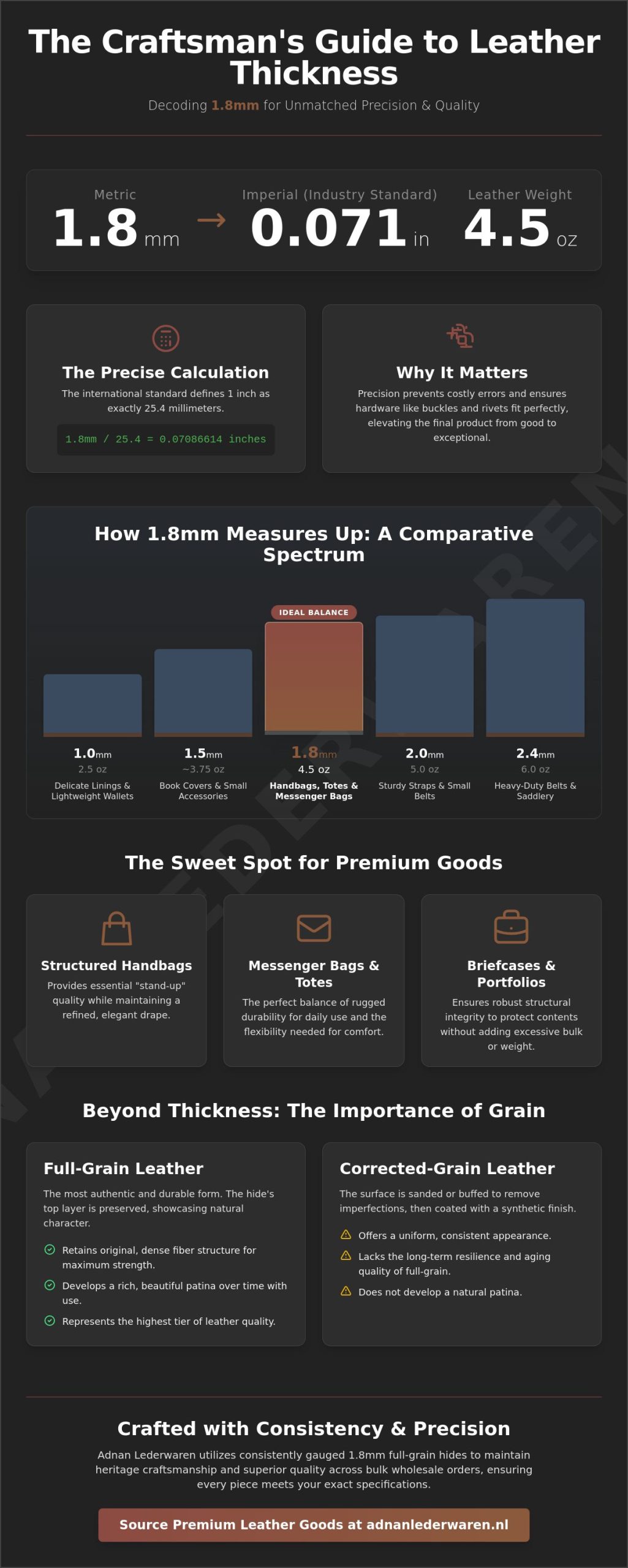
1.8mm leather represents a specific weight often categorized as 4.5 oz in the tanning industry. When you convert 1.8mm to inches, you get approximately 0.07 inches; a dimension that offers a reliable compromise between structural integrity and tactile softness. At Adnan Lederwaren, we’ve found that this specific thickness serves as the backbone for products that need to age gracefully while maintaining their original form.
Luxury retailers often prioritize structured handbags that maintain their silhouette even when empty. 1.8mm hides provide this “stand-up” quality without the need for heavy internal reinforcements or synthetic stiffeners. For messenger bags, this thickness ensures the flap closure remains flexible enough for daily use, while the main body resists the friction and abrasions common in urban environments. In the footwear sector, 1.8mm is the industry standard for sturdy boot uppers and casual shoes. It provides enough protection for the foot without requiring a painful “break-in” period that thicker 2.5mm hides might demand.
Many artisans and brands choose this weight for premium wholesale leather handbags. The density of a 1.8mm hide allows for deep, crisp embossing and laser engraving that won’t fade or warp as the leather fibers relax over time.
If you don’t have a digital caliper handy, think of a standard US nickel. A nickel measures approximately 1.95mm thick, so a 1.8mm piece of leather is just slightly thinner than that coin. If you’re in Europe, a 2-cent coin is 1.67mm thick; making 1.8mm leather feel slightly more substantial and “meaty” in the hand. When you perform a “hand-feel” test, you’ll notice the material resists sharp bending. It feels characterful and solid, which is why it’s the preferred choice for items that need to feel substantial without being cumbersome.
Working with 0.07-inch thick leather requires professional-grade tools to achieve a clean finish. When you’re calculating a 1.8mm to inches conversion for machine settings, remember that you’ll need a needle size between 110/18 and 125/20. Using a bonded nylon or polyester thread ensures the seams don’t fail under the tension that 1.8mm leather can exert.
Experience the difference that precise material selection makes by exploring our latest collection of handcrafted leather goods.
Adnan Lederwaren builds heritage collections on a foundation of exact measurements. Choosing 1.8mm hides isn’t a random decision; it’s the sweet spot for durability and flexibility in high-end goods. When you convert 1.8mm to inches, you get approximately 0.0709 inches. This specific thickness provides the structural integrity needed for bags that hold their shape for decades. Our heritage lines rely on this weight to ensure every seam and edge reflects our commitment to craft. We don’t compromise on these dimensions because the longevity of the leather depends on the density of the fibers at this exact thickness.
Our B2B wholesale partners rely on this level of detail. Consistency is often the biggest challenge in bulk leather sourcing, but we’ve eliminated that variable. Whether you’re ordering fifty or five hundred units, the thickness remains uniform. This reliability allows designers to plan their hardware and stitching patterns with total confidence. We also offer custom manufacturing for private label lines. If your brand requires a specific mm requirement for a unique design, our team adjusts the splitting process to meet your exact specifications. You can visit our showroom in Almere to feel the character and weight of our 1.8mm leather goods firsthand.
Consistency is the hallmark of professional leatherwork. We maintain a strict tolerance of +/- 0.05mm across our entire production line. We source full-grain hides specifically for 1.8mm applications to avoid excessive splitting, which can weaken the natural fibers. Our India-based production facilities operate under rigorous Dutch quality standards. This bridge between traditional tanning expertise and European precision ensures that every hide stays uniform from edge to edge. We use digital calipers at three different stages of production to verify that the 1.8mm to inches conversion remains accurate for international clients who require imperial measurements for their technical sheets.
Scale requires reliability. You can request samples of our 1.8mm leather handbags and accessories to experience the tactile quality of our work. Our experts are available to consult with you on the best thickness for your brand’s next collection. We’ll help you determine if 1.8mm is the right fit or if a slightly different weight would better serve your design goals. We value the personal connection of a family-run business while maintaining the capacity of a global supplier.
Ready to elevate your inventory with precision-crafted leather? Contact Adnan Lederwaren for B2B Wholesale Inquiries to discuss your specific requirements and request a sample pack.
Understanding the exact conversion of 1.8mm to inches is more than a simple math exercise; it’s about the long-term integrity of your craft. A thickness of 1.8mm, which equals approximately 0.0709 inches, provides the ideal structural balance for high-end handbags and durable leather accessories that need to hold their shape. Since 2010, our family-owned team has focused on these precise specifications to ensure every hide passes our strict Dutch quality control protocols. We’ve built our reputation as a specialized B2B wholesaler by providing consistent materials that artisans rely on for worldwide shipping requirements. Choosing the correct weight ensures your leather goods don’t just look good today but age with a characterful patina over many years. You’ll find that our deep passion for natural materials translates into a collection that honors traditional craftsmanship while meeting modern technical needs. We’re here to help you select the perfect thickness for your specific design goals. Explore our range of premium 1.8mm leather handbags today and experience the difference that professional-grade materials make in your daily work. We look forward to helping you create something truly timeless.
A thickness of 1.8mm is considered medium-to-heavy weight for a handbag. It provides a robust, structured feel that’s ideal for unlined tote bags or professional briefcases. This specific weight ensures the bag maintains its shape over years of use while showcasing the natural character of full-grain leather.
In our experience at Adnan Lederwaren, this thickness offers the perfect balance of durability and elegance. It’s thick enough to resist tearing at stress points but remains supple enough for comfortable daily carry. You’ll find it’s a favorite for artisans who value items that age beautifully with a distinct patina.
Leather measuring 1.8mm is approximately 4.5 ounces in weight. The industry standard conversion uses 1 ounce to represent 1/64 of an inch, which equals 0.4mm. Therefore, 1.8mm sits right between the 4oz and 5oz categories commonly used by American tanneries.
Choosing a 4.5oz hide gives your project a substantial feel without the excessive bulk of heavy saddle leather. It’s a versatile choice for craftsmen who need a material that’s both resilient and manageable during the cutting and assembly process.
Most domestic sewing machines aren’t designed to handle 1.8mm leather, especially when you’re stitching through two or more layers. You’ll likely encounter skipped stitches or a stalled motor if you don’t use a heavy-duty or industrial machine. For successful assembly, we recommend a size 110/18 leather needle and a walking foot attachment.
If you’re working on a home machine, stick to a single layer or use a specialized leather adhesive to reduce the load on the needle. Professional results often require the piercing power of an industrial machine to ensure the thread tension remains consistent across the entire seam.
The closest common fraction for 1.8mm to inches is 5/64 of an inch. While 1/16 of an inch is roughly 1.59mm, 1.8mm is slightly thicker, measuring exactly 0.0708 inches. This small difference is vital when you’re calculating tolerances for hardware like rivets or buckles.
Understanding the precise conversion of 1.8mm to inches helps you select the right tools and accessories for your leatherwork. Using a digital caliper will confirm these measurements to within 0.01mm, ensuring your handcrafted designs fit together with professional precision.
Yes, leather thickness significantly impacts wholesale costs because thicker hides require more tanning chemicals and longer processing times. Industry data shows that hides over 2.0mm often carry a price premium compared to thinner 1.0mm skins. The raw material’s weight directly influences the final price of the finished leather goods.
When you buy wholesale, you’re paying for the volume of the fiber structure. A 1.8mm full-grain hide contains more dense collagen fibers than a split leather alternative, which justifies the investment in quality. This sturdiness is what allows our products to stand the test of time.
You should use a specialized leather thickness gauge or a digital caliper to get an accurate reading at home. A standard ruler isn’t precise enough to distinguish between 1.6mm and 1.8mm. Always measure the hide in several spots, as natural leather thickness can vary by 0.2mm across the surface of a single skin.
Place the leather between the caliper jaws without squeezing too hard, as compressing the fibers will give you a false, thinner reading. For the most reliable data, measure the leather at room temperature and away from the stretchy edges of the hide.
A single layer of 1.8mm leather is generally too thin for a durable waist belt. Most high-quality belts require a thickness between 3.5mm and 4.0mm to prevent the leather from stretching or warping under tension. However, 1.8mm leather is an excellent choice for the top layer of a lined and stitched belt.
By bonding two layers of 1.8mm leather together, you create a 3.6mm belt that’s incredibly strong and features a finished look on both sides. This technique is common in luxury leatherwork where a refined aesthetic is just as important as functional strength.
European and Asian tanneries typically use the metric system, while tanneries in the United States traditionally measure in ounces. This regional difference can be confusing when you’re sourcing materials globally. Knowing how to convert 1.8mm to inches ensures you’re getting the exact weight required for your specific design.
The ounce measurement refers to the weight of one square foot of leather. Since leather density is relatively consistent, weight serves as a reliable proxy for thickness. At Adnan Lederwaren, we provide both measurements to help our international clients understand the tactile quality of our handcrafted collections.


You deal directly with the manufacturer. We control planning, quality and pricing ourselves.

One point of contact from first question to delivery. English, Dutch and German.

Approve a physical sample first. We are happy to sign your NDA.

Incoming leather, after cutting, during production, and a final inspection before dispatch.
 English English
 Nederlands
 Deutsch
 Français
 Italiano
 Español
Comments are closed.