

Own family facility
You deal directly with the manufacturer. We control planning, quality and pricing ourselves.
Did you know that the fashion industry standard markup for a leather handbag can reach up to twelve times its physical production cost? For many brand owners, the true cost breakdown of manufacturing a leather handbag remains an opaque mystery that makes it difficult to balance artisan quality with a viable retail price. You’ve likely felt the pressure of rising material costs and those unexpected import duties that seem to appear out of nowhere. It’s a challenge to maintain the integrity of a beautifully crafted product while ensuring your business stays profitable in the 2026 market.
This guide promises to demystify those numbers, giving you the knowledge to distinguish between fair artisan pricing and simple overcharging. We’ll explore the strategic 40/30/20/10 rule, which allocates funds across materials, labor, overhead, and logistics. By understanding these specific percentages and the impact of current tariffs, you’ll gain a clear roadmap to optimize your sourcing strategy. We’re going to break down every line item, from the first hide of supple leather to the final shipping fee, so you can build a collection that reflects both your high standards and your business goals.
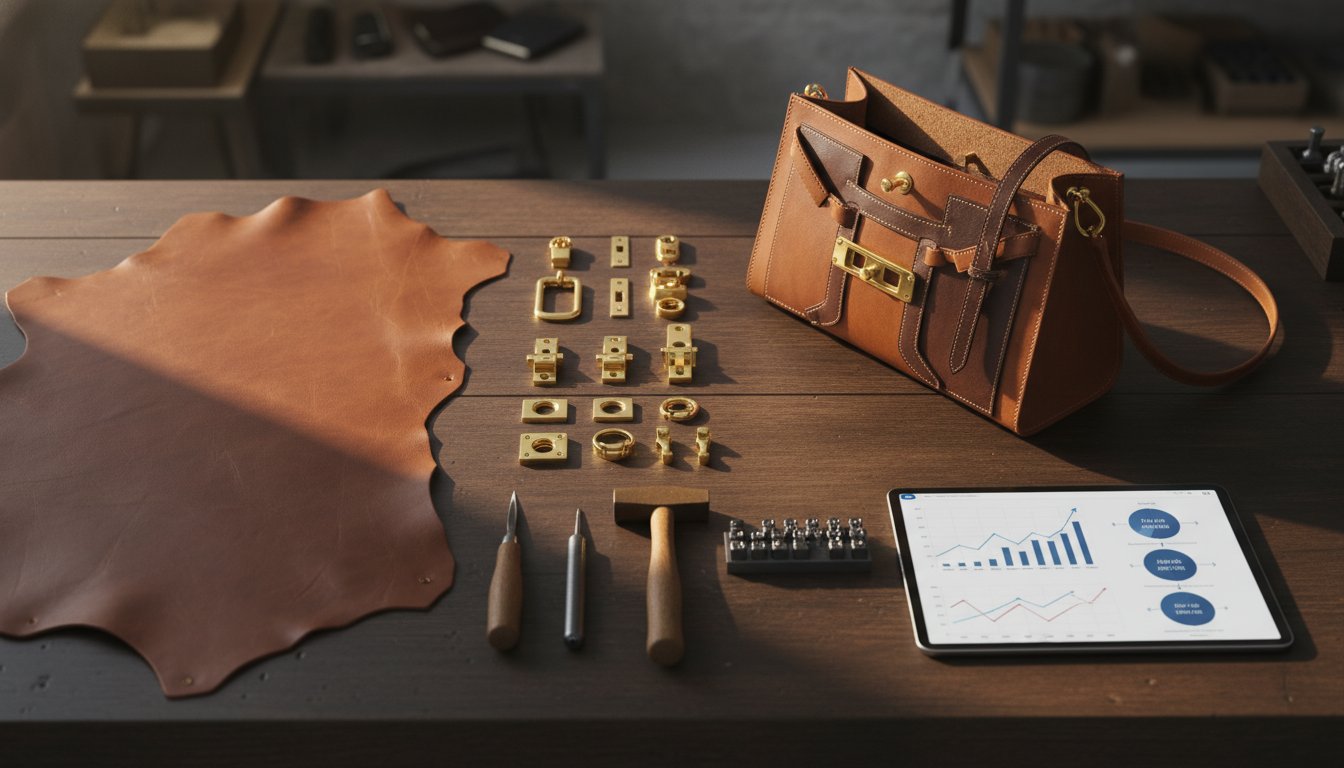
The materials you choose define the soul of your product. In any professional cost breakdown of manufacturing a leather handbag, raw materials and hardware typically represent the largest investment, often accounting for 40% to 50% of the total production price. This isn’t just about the leather itself; it’s about the harmony between the exterior skin, the internal structure, and the metallic accents that provide functionality. Choosing between chrome-tanned and vegetable-tanned leather is a pivotal decision. While chrome tanning is faster and more cost-effective, vegetable-tanned leather offers a rich, organic patina that evolves over time, though it comes with a significantly higher price tag due to the artisanal, time-intensive process.
To better understand how these material choices and construction methods impact the final value of a luxury item, watch this helpful video:
The grade of leather you select dictates both the tactile experience and the long-term durability of the bag. Full-grain leather, which retains the natural grain and strength of the hide, sits at the top of the pricing hierarchy. Top-grain or corrected leathers are more uniform but often require more chemical processing. You must also consider “yield.” Complex designs with many panels can require up to 20% more raw hide because of wastage around natural imperfections. Interestingly, hides sourced from European tanneries often command a premium over Asian alternatives because of stricter environmental regulations and animal husbandry standards. This evolution of material usage is a far cry from the utilitarian roots found in the history of the handbag.
Hardware is the jewelry of a handbag. Opting for solid brass with PVD coating ensures longevity and resistance to tarnishing, whereas zinc alloy is a lighter, more budget-friendly alternative that may wear down faster. Even zippers play a significant role in the cost breakdown of manufacturing a leather handbag. The difference between standard nylon and premium polished metal teeth is felt every time a customer opens the bag. Don’t overlook the “hidden” costs like internal reinforcements, specialized glues, and custom branding elements like embossing plates or custom pulls. These small details ensure the bag maintains its shape and identity over years of use.
While the selection of fine leather sets the stage, the hands that cut and stitch the material determine the final character of the piece. In a standard cost breakdown of manufacturing a leather handbag, labor generally represents between 25% and 35% of the total production expenditure. This figure isn’t arbitrary; it’s calculated using the “Minutes per Bag” metric. This measurement tracks the exact time an artisan spends on each stage, from clicking the leather to the final edge painting. Complexity is the primary driver here. A simple unlined tote might take ninety minutes, while a structured frame bag with multiple internal compartments could require several hours of focused attention.
Artisan skill level is a critical variable that distinguishes premium goods from mass-market items. Skilled techniques like hand-stitching and meticulous edge painting command a premium because they require years of training and a steady hand. These details aren’t just aesthetic; they ensure the longevity of the bag. When analyzing fashion industry labor statistics, it becomes clear that specialized leather artisans are becoming a rare resource, driving up costs for brands that refuse to compromise on quality.
The location of your production facility significantly shifts your unit costs. In 2026, labor rates in regions like China or Vietnam hover between $2 and $5 per hour, whereas US-based labor often ranges from $10 to $30 per hour. However, a lower unit price often introduces higher quality control risks. Many brands find the most sustainable path involves European management within overseas facilities to bridge the gap between efficiency and high standards. Ethical manufacturing also carries a cost. Fair wages, safe working conditions, and regular social compliance audits are essential investments for brands that value integrity as much as profit.
The structure of the bag dictates the labor intensity. A structured frame bag requires precise internal reinforcements that a slouchy hobo bag does not. Adding intricate details like piping, multiple zippered compartments, or adjustable straps increases the “Minutes per Bag” significantly. Production volume also plays a role. Higher Minimum Order Quantities (MOQs), which have averaged around 200 to 300 pieces in 2025, allow for better labor efficiency as artisans become more proficient with a specific design. If you’re looking for a partner that understands these nuances, exploring the B2B leather manufacturing services offered by experts can help you balance these human costs with your retail goals.
Creating a new silhouette is a technical investment that goes far beyond a simple sketch. In a professional cost breakdown of manufacturing a leather handbag, these front-end expenses are categorized as fixed investments. They don’t fluctuate based on the size of your order, which means they must be carefully amortized across your entire production run. If you’re launching a small collection, these development costs will represent a larger portion of your per-unit price compared to a high-volume run. Skimping on this phase is a common mistake; a weak foundation leads to expensive errors once the production line is moving.
The Tech Pack is the most critical document in this phase. It acts as the definitive blueprint, containing every technical detail from exact stitch counts to the precise placement of reinforcements. According to a comprehensive leather goods manufacturing cost report, the precision of your initial design documentation is what prevents material waste and production delays. In the 2026 market, professional Tech Packs and CAD designs typically range from $500 to $2,000 per style. This investment ensures that the factory understands your vision perfectly, reducing the need for multiple, costly revisions.
Translating a 2D vision into a 3D object requires the expertise of a master artisan. While CAD design is increasingly popular for its scalability and ease of adjustment, many high-end studios still rely on hand-drafted patterns to capture a specific “feel” or drape. For brands planning high-volume production, creating custom metal dies is a necessary setup cost. These cutting tools ensure every leather panel is identical, but they represent a one-time fee that can range from $500 to $1,000 depending on the bag’s complexity.
The sampling cycle is where your design is truly tested. Manufacturers usually charge a premium for initial prototypes, often up to three times the final production price. This reflects the labor-intensive process of an artisan manually constructing a single unit and sourcing small quantities of materials. It’s standard to go through one or two rounds of revisions before reaching the “Golden Sample.” This final version serves as the quality benchmark for your entire manufacturing run, ensuring the bags your customers receive match the quality of your original vision.
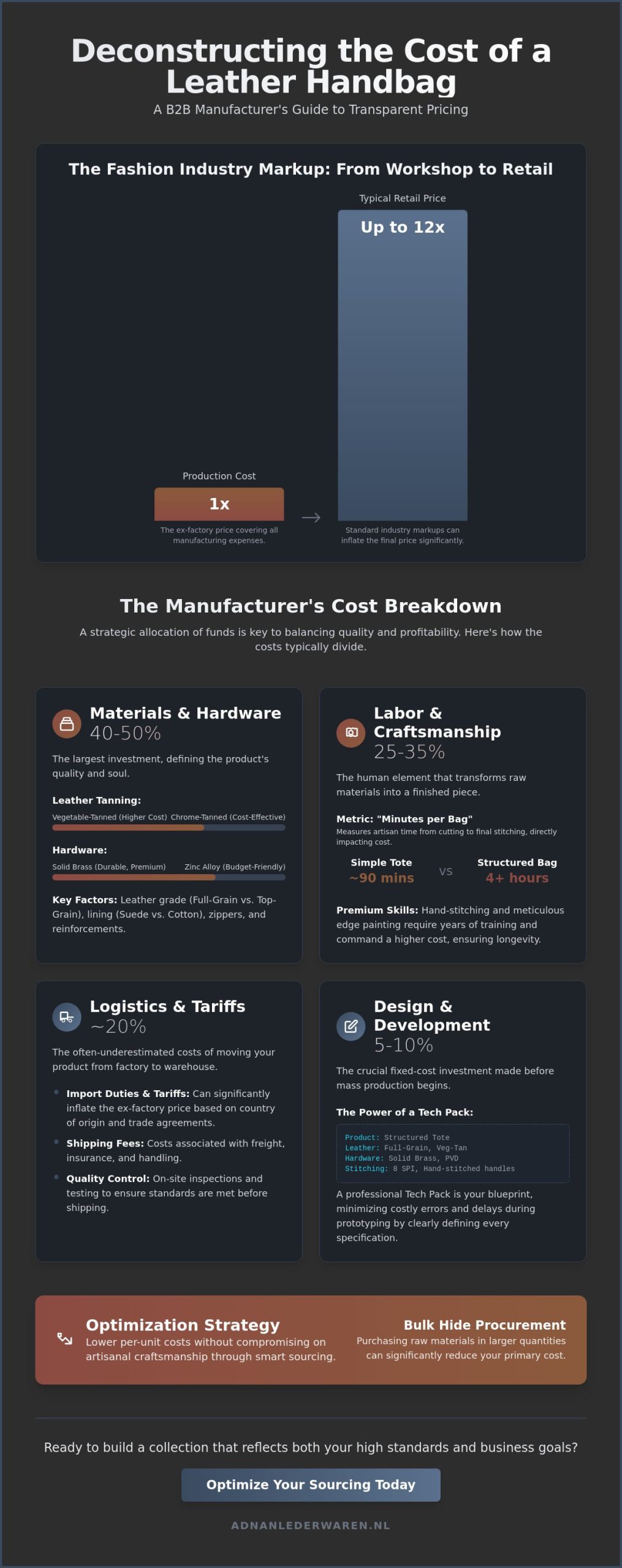
The “ex-factory” price is often a seductive number, but it rarely reflects the final financial reality of your production run. In any realistic cost breakdown of manufacturing a leather handbag, you must account for “landed costs,” which typically add 10% to 20% to your initial quote. These factors include everything from the physical movement of goods to the regulatory hurdles required to cross international borders. Neglecting these figures can quickly erode your retail margins and disrupt your financial planning for the 2026 season. It’s the difference between a profitable collection and one that merely breaks even.
Navigating import duties and tariffs requires a keen eye for detail and an understanding of HS codes. For instance, US import duties on leather handbags under HTS code 4202.21 generally carry a base rate of 8% to 16%. However, trade policies remain volatile. If you’re sourcing from certain regions, additional tariffs like the Section 301 charges can add another 7.5% to 25% to your bill. You also need to factor in the Merchandise Processing Fee, currently set at 0.3464% of the shipment’s value, and the Harbor Maintenance Fee of 0.125% for sea shipments. These small percentages might seem negligible on a single unit, but they become significant when moving hundreds of pieces across the ocean.
Choosing between air and sea freight is a balance of speed and per-unit profitability. While air freight offers rapid replenishment for high-demand collections, it significantly increases the cost per bag, especially for structured designs that cannot be flattened. Sea freight is the economical choice for bulk orders, though it requires longer lead times and higher insurance premiums to protect your B2B investment. Calculating the volume (CBM) of your shipment is vital; structured bags take up more space than soft clutches, which directly impacts your freight bill. Protecting these items with proper insurance and brokerage fees is a non-negotiable part of a secure supply chain.
Quality control is an investment in your brand’s reputation and long-term integrity. While some factories offer internal checks, many successful brands employ third-party inspectors to ensure a 100% inspection rate. This proactive approach is far more cost-effective than dealing with a 5% return rate from dissatisfied retailers. Acceptable Quality Level (AQL) testing covers everything from the colorfastness of the leather to the pull-strength of the hardware. Understanding how to assess the quality of a leather tote bag before it leaves the factory floor is the best way to safeguard your margins. Packaging and presentation, including dust bags and retail-ready labeling, also add to the final tally but are essential for a premium consumer experience.
To ensure your next collection is both beautiful and profitable, it helps to work with a partner who values transparency. You can request a detailed B2B manufacturing quote to see how we manage these hidden factors with precision and care.
Achieving a sustainable profit margin requires more than just finding the lowest quote. At Adnan Lederwaren, we’ve refined a B2B model that harmonizes traditional Dutch quality control with highly efficient production methods. By managing the supply chain with artisanal pride, we help our partners navigate the complex cost breakdown of manufacturing a leather handbag without sacrificing the integrity of the final product. One of our primary strategies involves the bulk procurement of premium hides. Because we secure large quantities of high-grade leather directly from trusted tanneries, we’re able to pass those savings on to you, effectively lowering your base material costs from the very start.
Transparency is at the heart of our partnership. We don’t believe in hidden markups on hardware or logistics; instead, we focus on helping you scale your collection profitably. When you increase your order volume from a niche run of 50 units to a more robust 500 pieces, the per-unit cost drops significantly as labor efficiencies and material yields improve. For brands looking to enter the market quickly, leveraging our existing silhouettes can completely eliminate the development and prototyping costs we discussed earlier. This allows you to focus your resources on marketing and distribution while we handle the technical complexities of the creation process.
Strategic scaling is about more than just numbers; it’s about making informed choices. Understanding how to choose a leather goods manufacturer is the first step in ensuring your production partner can grow with you. By utilizing proven patterns and established supply lines, you can reduce the initial financial burden of new designs while maintaining the high standards your customers expect. Our hybrid approach ensures that even as you scale, the tactile quality of the leather and the precision of the stitching remain consistent across every single piece.
In the competitive leather goods market, “cheap” manufacturing often becomes an expensive mistake. Poor stitching, inferior hardware, and inconsistent leather grades lead to high return rates and lasting damage to your brand’s reputation. We stand by our guarantee of consistency, ensuring that every piece in your production run reflects the same level of care as the initial sample. This reliability is what builds long-term trust between a brand and its retailers. It’s an investment in the longevity of your business. To see how our collection can enhance your store’s offering, Request Our B2B Leather Goods Catalog Today and discover the difference that artisanal expertise makes.
Mastering the cost breakdown of manufacturing a leather handbag is the first step toward creating a brand that balances timeless elegance with commercial success. You’ve seen how the interplay between raw hide quality, artisan labor, and logistical precision shapes your final landed cost. By accounting for development fixed costs and navigating the complexities of international tariffs, you place your business in a position of strength rather than uncertainty. This knowledge allows you to protect your margins while maintaining the high standards your customers expect.
Since 2010, our family-owned business has specialized in bridging the gap between artisanal craftsmanship and reliable B2B manufacturing. We combine rigorous Dutch quality standards with global distribution networks to ensure your vision reaches the market exactly as intended. Whether you’re refining an existing silhouette or scaling a new collection, we’re here to provide the transparency and expertise you need to thrive. We invite you to take the next step in your production journey with a partner who values quality as much as you do.
Partner with Adnan Lederwaren for Transparent B2B Manufacturing
Let’s work together to turn your design concepts into durable, high-quality reality. Your success in the 2026 market starts with a foundation of trust and technical excellence.
The total production cost is typically determined by the 40/30/20/10 rule, which balances materials, labor, overhead, and logistics. Because every design is unique, the final figure depends on the specific leather grade and the complexity of the construction. You’ll find that premium full-grain leather and skilled artisanal labor represent the largest portions of this financial commitment.
Professional prototyping for complex designs typically ranges from $500 to $1,000 per style. This initial investment covers the master artisan’s time to translate your 2D sketches into a 3D form and the cost of sourcing small quantities of high-quality materials. While this is higher than the per-unit production price, it’s a vital step to ensure the integrity of your final collection.
Vegetable tanning is a slow, traditional process that uses natural tannins and can take several weeks or even months to complete. This is a significant contrast to chrome tanning, which is a faster, chemical-heavy method. The extra time and artisanal care required for vegetable tanning result in a supple material with a rich patina that many high-end brands find worth the higher investment.
Yes, the geographic location of your factory shifts the weight of different line items in your cost breakdown of manufacturing a leather handbag. While regions with lower hourly wages might reduce direct labor expenses, they often require higher investments in European management and third-party quality control. You must balance these lower unit costs against the potential risks to your brand’s reputation and consistency.
Higher MOQs lower your per-unit cost by spreading fixed expenses, such as tech pack development and custom metal dies, across a larger number of items. In 2025, average MOQs have settled around 200 to 300 pieces. Scaling your order allows artisans to reach peak efficiency and helps you secure better rates when purchasing premium hides in bulk.
Logistics, import duties, and quality control inspections are the most frequent hidden factors in the cost breakdown of manufacturing a leather handbag. Landed costs can add up to 20% to your ex-factory price. You must also account for specific regulatory fees, such as the Merchandise Processing Fee and the Harbor Maintenance Fee, which are essential for a smooth B2B supply chain.
You can optimize your budget by leveraging existing “White Label” silhouettes or simplifying your hardware choices. Using established patterns eliminates the need for expensive new pattern-making and custom cutting dies. Another effective strategy is bulk procurement of hides, which allows you to maintain the use of full-grain leather while benefiting from a lower price per square foot.
Synthetic alternatives are generally less expensive, with coated textiles often costing between $5 and $15 per yard. This is significantly lower than premium full-grain leather, which can range from $25 to $50 per square foot. However, it’s important to remember that these materials often lack the durability, breathability, and aesthetic evolution that define a high-quality leather product.


You deal directly with the manufacturer. We control planning, quality and pricing ourselves.

One point of contact from first question to delivery. English, Dutch and German.

Approve a physical sample first. We are happy to sign your NDA.

Incoming leather, after cutting, during production, and a final inspection before dispatch.
 English English
 Nederlands
 Deutsch
 Français
 Italiano
 Español
Comments are closed.