

Own family facility
You deal directly with the manufacturer. We control planning, quality and pricing ourselves.
In a market where 68% of luxury consumers prioritize bespoke craftsmanship over mass-produced items, your brand’s visual identity isn’t just a logo; it’s the specific, inimitable shade of the leather itself. You know that a standard “tan” or “navy” isn’t enough to stand out on a crowded shelf. You’ve likely felt the frustration of receiving a batch where the colors bleed or don’t match the previous production run, making it nearly impossible to maintain a cohesive collection of handbags and wallets. This is where custom color dyeing for private label leather becomes your most powerful tool for market exclusivity.
We understand that achieving a signature color requires a delicate balance of artisanal pride and technical precision. This guide will help you discover how custom color dyeing can differentiate your private label leather goods and the technical steps to achieve brand-perfect results. We’ll explore the nuances of color matching, how to navigate MOQs without sacrificing quality, and the steps to building a reliable B2B partnership that protects your brand’s aesthetic integrity. From meeting the latest 2026 Oeko-Tex standards to ensuring long-term durability, you’ll learn how to create pieces that age with character and class.
Custom color dyeing for private label leather is more than a manufacturing choice; it’s a strategic investment in brand equity. While many suppliers offer a standard palette of blacks, browns, and tans, true differentiation happens when you step outside the catalog. This process involves precisely matching pigments to your brand’s specific vision. It ensures that your leather handbags and accessories carry a visual signature that’s impossible to find elsewhere. The depth and vibrancy of the finish are achieved during the crusting stage of the leather production process, where the material is prepared to absorb dyes deeply and evenly.
In an era where leather prices have risen by nearly 22% as of early 2026, brands must justify their price points through exclusivity. When your products are finished in a bespoke hue, you move away from being a commodity. You aren’t just selling a leather tote bag; you’re selling a curated piece of your brand’s story. It’s about creating an emotional connection through color that resonates with a discerning audience.
To better understand the technical skill involved in achieving these results, watch this helpful video:
Relying on generic shades limits your ability to align with seasonal trends or maintain a cohesive aesthetic across different categories. If your leather belts don’t perfectly match your leather laptop bags because they were sourced from different stock lots, the perceived value of your collection drops. Custom dye lots solve this by ensuring every piece, from leather keychains to leather jackets, shares the exact same chromatic DNA. It allows for precise brand storytelling through subtle nuances in tone that reflect your brand’s maturity and attention to detail.
Data from 2026 shows that 68% of luxury consumers prioritize unique, bespoke craftsmanship over mass-produced items. A signature color becomes a hallmark that customers recognize instantly. It acts as a silent logo. By using custom color dyeing for private label leather, you effectively “de-commoditize” your offerings. When a competitor cannot replicate your specific shade of burnt orange or deep emerald, the consumer stops price-shopping. They start valuing the unique aesthetic you provide. This strategy is essential for targeting demographics who seek longevity, character, and a sense of timeless class in their leather goods.
Selecting the right hide is the foundational step in custom color dyeing for private label leather. Full-grain leather remains the gold standard for this process because its intact fibrous structure and natural pores allow for superior dye absorption. Unlike corrected leathers that have been sanded down, full-grain hides retain their ability to take on pigments while maintaining the unique character of the animal skin. This choice ensures that the final product doesn’t just look colored; it looks like the color is part of the material itself.
The actual transformation occurs during the drum dyeing process. Hides are placed in large, rotating drums filled with a precise mixture of dyes, oils, and water. The mechanical tumbling action forces the pigments deep into the leather’s core. It’s a slow, careful immersion that guarantees a rich, lasting finish. To maintain consistency across different production batches, technicians must meticulously control the chemistry. This involves monitoring pH levels and water temperature with expert precision. Even a minor fluctuation can cause the leather to reject the dye or result in a shade that deviates from your brand’s approved sample.
Once the desired hue is achieved, post-dyeing finishes are applied to lock in the color. These treatments protect the leather from UV rays, which can cause fading over time, and provide a barrier against moisture and everyday wear. This technical rigor ensures that your collection retains its elegance from the showroom to the customer’s hands.
Aniline dyeing uses transparent dyes that showcase the leather’s natural grain, markings, and scars. It offers a “naked” feel that is highly prized in the luxury market. However, because it lacks a heavy protective coating, it’s more susceptible to staining. Semi-aniline dyeing offers a middle ground. It involves a light layer of pigment and a thin protective sealer. This method provides better color uniformity and durability, making it an excellent choice for functional items like leather backpacks or daily-use wallets that require a balance of beauty and resilience.
Dye absorption is heavily influenced by the weight and thickness of the hide. A heavy 3.5mm hide intended for leather belts requires a longer “wet-end” processing time than a thin 0.8mm hide used for delicate cardholders. If the process is rushed, the dye may only sit on the surface. This results in “grinning,” where the pale, undyed center of the leather becomes visible whenever the material is cut or folded. Achieving true depth means ensuring the pigment reaches the very center of the hide, providing a consistent look that signifies high-end craftsmanship.
Deciding between stock leather and custom dye lots is a pivotal choice for any growing brand. Stock colors are readily available and cost-effective for smaller runs, but they lack the distinctiveness that defines a premium label. When you opt for custom color dyeing for private label leather, you’re making a long-term investment in your brand’s visual identity. While the initial investment is higher, the equity you build through exclusivity often outweighs the upfront costs. It’s about moving from a generic product to a signature piece that carries your brand’s unique DNA.
Minimum Order Quantities (MOQs) are a standard reality in B2B manufacturing. For custom color runs, suppliers often require a minimum of five hides or approximately 50 units for standard private label production. If your project is fully bespoke, these requirements might increase to 200 or 300 units. You also need to account for longer lead times. Custom dyeing adds several weeks to your production calendar compared to using off-the-shelf materials. This extra time allows for better risk management. By dyeing a single large lot, you eliminate the “batch variance” that often occurs when stock leather is sourced from different production cycles at different times.
Stock colors serve a purpose for brands testing a new market or launching a rapid-entry collection. They lower the barrier to entry and reduce financial risk for trial accessories like leather cardholders or keychains. It’s an ideal path for “white label” strategies where speed is more important than total exclusivity. The trade-off is brand dilution. If your competitors use the same “Chestnut” or “Midnight Blue” from the same wholesaler, your product becomes easily replaceable. It’s harder to command a premium when the customer sees the same material elsewhere.
Choosing custom dye lots creates a competitive “moat” around your business. It allows you to charge premium prices because your products possess a unique aesthetic that can’t be price-shopped. This approach strengthens your collaboration with your leather goods manufacturer, as it requires deeper technical alignment and trust. By securing exclusive materials, you ensure your leather backpacks and duffel bags aren’t just another item on the shelf. They become a true representation of your brand’s artisanal standards and commitment to quality.
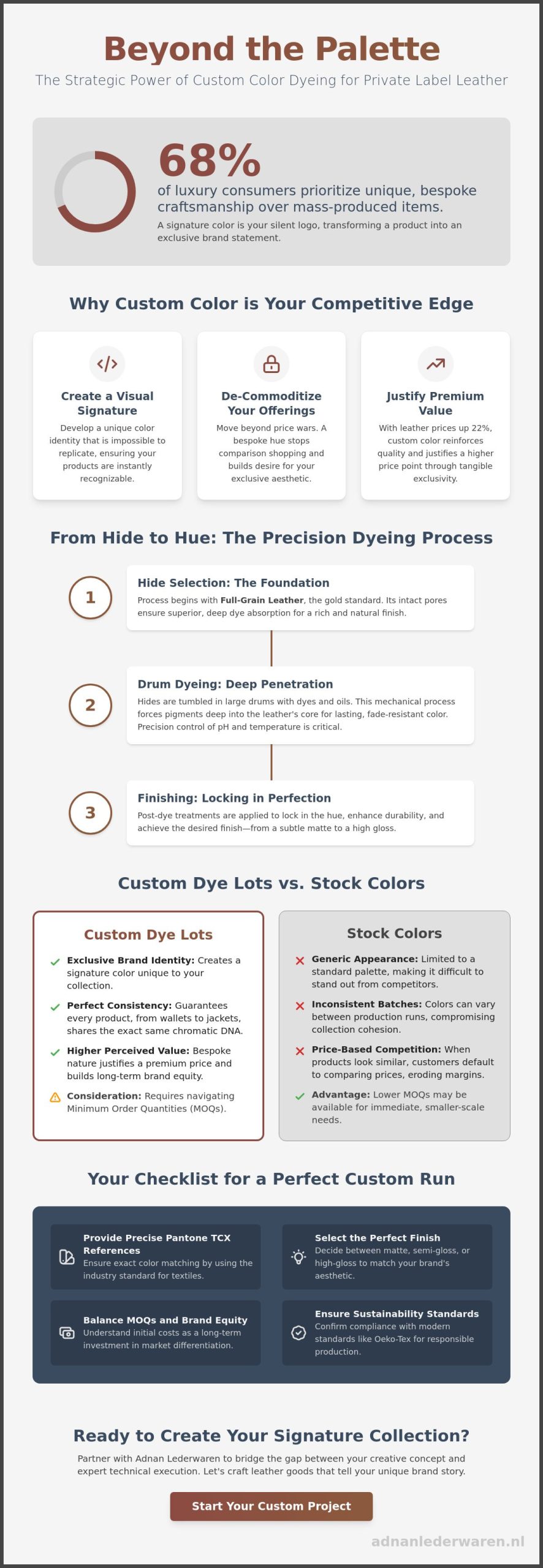
Successful custom color dyeing for private label leather depends on clear communication and technical preparation. You don’t just pick a color; you define a material’s future. Before starting your production run, you must consider how the dye interacts with your chosen substrate. For instance, the same pigment will look vastly different on a porous suede than it does on a dense pebble-grain leather. Suede absorbs light and dye deeply, creating a muted, velvety tone, while pebble grain reflects light off its textured surface, often making the color appear more vibrant.
Defining the final finish is equally vital. Do you want a soft matte look that feels contemporary, or a high-gloss sheen for a classic aesthetic? You might even consider metallic effects for seasonal statement pieces. Beyond aesthetics, your choices must align with evolving global standards. By October 10, 2026, new REACH restrictions on PFHxA and related substances will apply to leather goods in the EU. Ensuring your manufacturing partner uses LWG-compliant or REACH-certified dyes isn’t just about ethics; it’s a legal necessity for international brands.
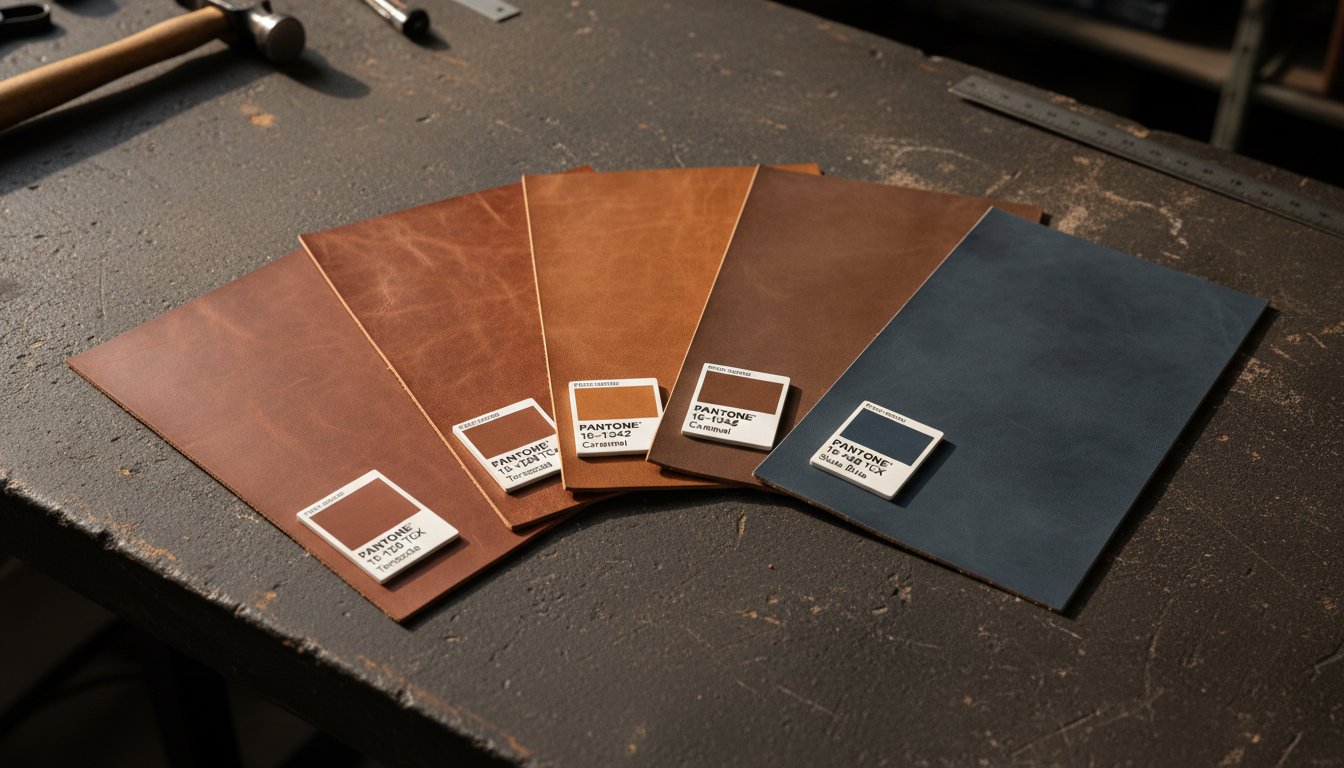
Digital screens are notoriously unreliable for color accuracy. We always recommend using physical Pantone TCX (Textile) swatches rather than digital references. Leather is a natural material that experiences a “dry-back” effect, where the color shifts slightly as the moisture evaporates after the dyeing process. To manage this, the approval process starts with “lab dips.” These are small samples of your specific leather dyed to your Pantone reference. You should review these in various lighting conditions—daylight, office light, and retail environments—before giving the green light for full-scale production.
Your leather needs to perform as well as it looks. This means specifying requirements for colorfastness to light and resistance to “crocking,” which is the transfer of dye through rubbing. High-use items like those found in our guide to wholesale leather handbags require superior durability to ensure the color doesn’t fade or stain a customer’s clothing. If you’re exporting to multiple regions, verify that your dye lots meet specific chemical restrictions for those markets. Taking these steps early prevents costly delays and ensures your collection meets the high standards your audience expects.
If you’re ready to bring your brand’s unique palette to life with expert precision, explore our custom manufacturing options to see how we can assist your next collection.
Adnan Lederwaren isn’t just a supplier; we’re an extension of your brand’s creative team. Our heritage is rooted in family-led production where artisanal pride meets modern industrial efficiency. We’ve spent years perfecting the art of custom color dyeing for private label leather, ensuring that every hide we process reflects the integrity and class our partners expect. Whether you’re a boutique label or a global distributor, our expertise helps you translate a vision into a tangible, high-quality product that stands the test of time. We believe that the beauty of leather lies in its natural origins, and our role is to enhance that beauty through technical precision.
Transitioning from a design concept to a dyed-to-match production run requires more than just machinery. It demands a deep understanding of how natural materials react to pigments. We manage this transition through rigorous quality control protocols. This ensures that the specific shade of emerald or navy you approved in the lab dip stage remains consistent across a bulk order of several hundred units. We focus on the intrinsic value of the material, using LWG-certified tanneries and adhering to SA8000 social accountability standards. This commitment to ethics and quality is what allows our partners to market their collections with absolute confidence in their supply chain.
The journey begins with collaborative design sessions. We don’t just take an order; we discuss the tactile utility and aesthetic evolution of your collection. Our production capabilities are diverse, spanning from intricate leather cardholders and RFID wallets to robust leather backpacks and duffel bags. We’ve developed a workflow that allows us to scale seamlessly. We can handle small specialty runs for a seasonal launch or manage the logistics for global distribution without compromising on the personal attention that defines our brand. Every leather belt or laptop bag we produce is a testament to the care we put into the creation process.
Transparency is the cornerstone of our B2B relationships. In a global market that can often feel distant and opaque, we offer direct access to manufacturing expertise and technical support. We understand that your production calendar is a critical business asset. That’s why we prioritize strict adherence to timelines and maintain open, honest communication throughout the dyeing and assembly phases. Our Dutch roots influence our approach to business: we’re stable, reliable, and deeply committed to delivering European quality standards. We invite you to contact us to discuss your custom color requirements and discover how our passion for craftsmanship can elevate your next collection.
Choosing a signature palette is the first step toward building a collection that resonates with the modern luxury consumer. By moving beyond stock options, you create a visual language that competitors simply cannot replicate. We’ve explored how the technical mastery of drum dyeing and precise Pantone matching ensures your brand’s integrity remains intact across every production run. Investing in custom color dyeing for private label leather isn’t just about aesthetics. It’s a strategic move to de-commoditize your offerings and command the premium your craftsmanship deserves.
Since 2010, Adnan Lederwaren has served as a specialized B2B manufacturer, bridging the gap between creative vision and technical execution. Whether you require traditional full-grain leather or high-performance vegan leather solutions, our global wholesale distribution capabilities ensure your collection reaches its audience with uncompromising quality. We’re here to help you navigate the complexities of international standards while maintaining the personal touch that defines a family-led business.
Your brand’s next iconic shade is waiting to be discovered. Request a Quote for Your Custom Private Label Collection and let’s begin crafting a legacy of quality together.
The minimum order quantity for custom color dyeing for private label leather typically starts at five hides or approximately 50 units for standard production. For fully bespoke designs, this requirement often increases to 200 or 300 units. These minimums allow us to calibrate our machinery and pigments precisely, ensuring the technical setup for a unique dye lot remains efficient while maintaining the high standards your brand requires.
Yes, we can match specific Pantone TCX (Textile) codes to ensure your leather handbags align perfectly with your brand identity. Because leather is a natural substrate, we always begin with lab dips to account for the material’s unique absorption. This physical approval process is essential for achieving the exact depth and tone you envision. It’s a collaborative effort that guarantees your signature shade is replicated with absolute precision.
Custom color dyeing for private label leather typically adds several weeks to the standard production calendar. This extra time is necessary for color matching, lab dip approval, and the careful drum dyeing process itself. Planning for this duration ensures that every batch meets our strict quality protocols without rushing the artisanal transformation of the hide. It’s a stable approach that prioritizes longevity and class over speed.
Professional drum dyeing preserves the natural, supple feel of the leather while ensuring the color penetrates the core. Unlike heavy surface coatings, this method maintains the hide’s breathability and soft texture. We apply post-dyeing finishes that protect against UV rays and rubbing, ensuring the finish remains durable throughout years of use. It’s a process that respects the material’s origin while enhancing its functional life for your customers.
Drum dyeing involves immersing hides in rotating drums to saturate the fibers completely, whereas surface pigmenting only applies color to the top layer. Drum dyeing is the superior choice for luxury goods because it prevents “grinning” when the leather is cut or scratched. It results in a richer, more authentic appearance that ages with grace. This method highlights the intrinsic value of the full-grain leather rather than masking it with synthetic layers.
We prioritize the use of REACH-certified and LWG-compliant dyes to meet the latest 2026 environmental standards. As of June 1, 2026, all wet processes must adhere to stricter Oeko-Tex requirements regarding hazardous substances. Our commitment to these regulations ensures your private label collection is safe for consumers and compliant with international export laws. It’s part of our dedication to transparent, ethical manufacturing for all our partners.
While minor natural variations can occur between hides, we use precise pH and temperature controls to maintain high consistency across large orders. By dyeing your entire collection in a single custom dye lot, we eliminate the batch variance often found in stock leathers. This technical rigor ensures a uniform look for your brand’s handbags and wallets, protecting the cohesive aesthetic that represents your identity.


You deal directly with the manufacturer. We control planning, quality and pricing ourselves.

One point of contact from first question to delivery. English, Dutch and German.

Approve a physical sample first. We are happy to sign your NDA.

Incoming leather, after cutting, during production, and a final inspection before dispatch.
 English English
 Nederlands
 Deutsch
 Français
 Italiano
 Español
Comments are closed.