

Own family facility
You deal directly with the manufacturer. We control planning, quality and pricing ourselves.
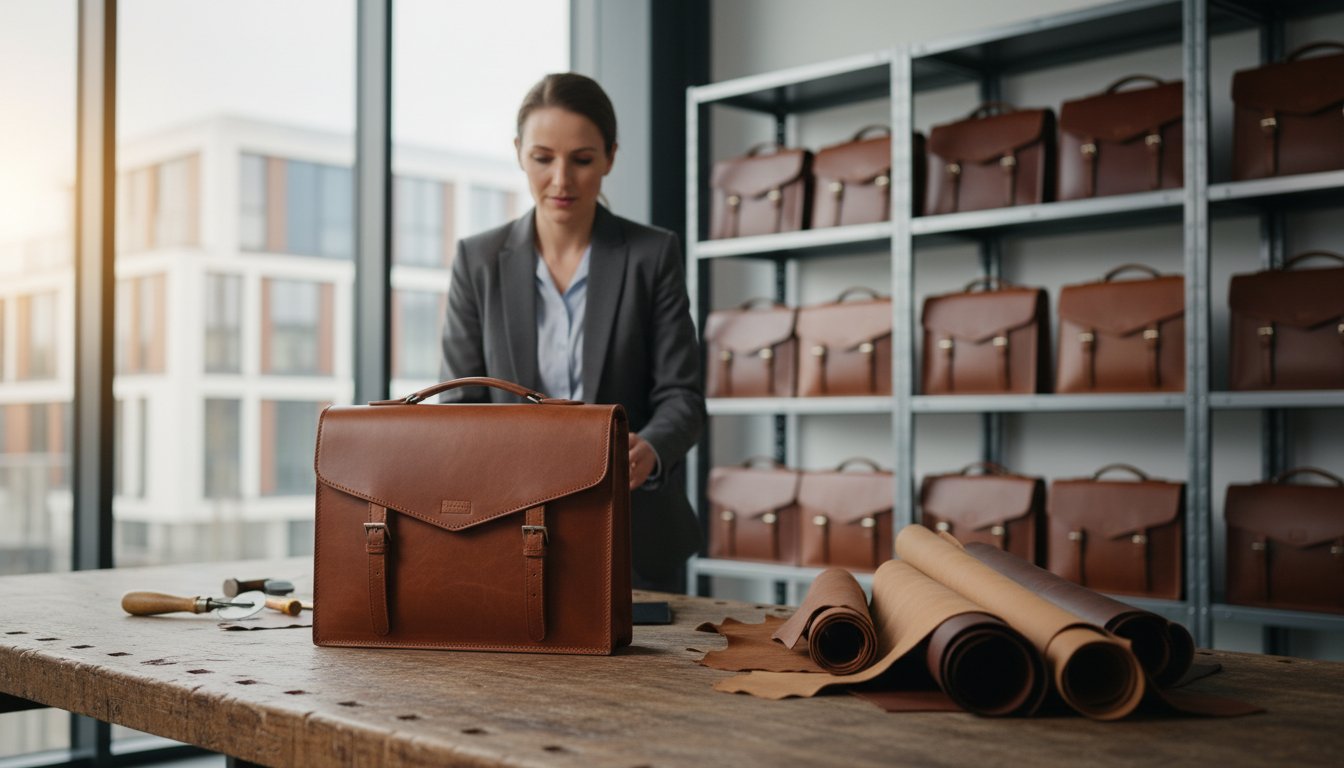
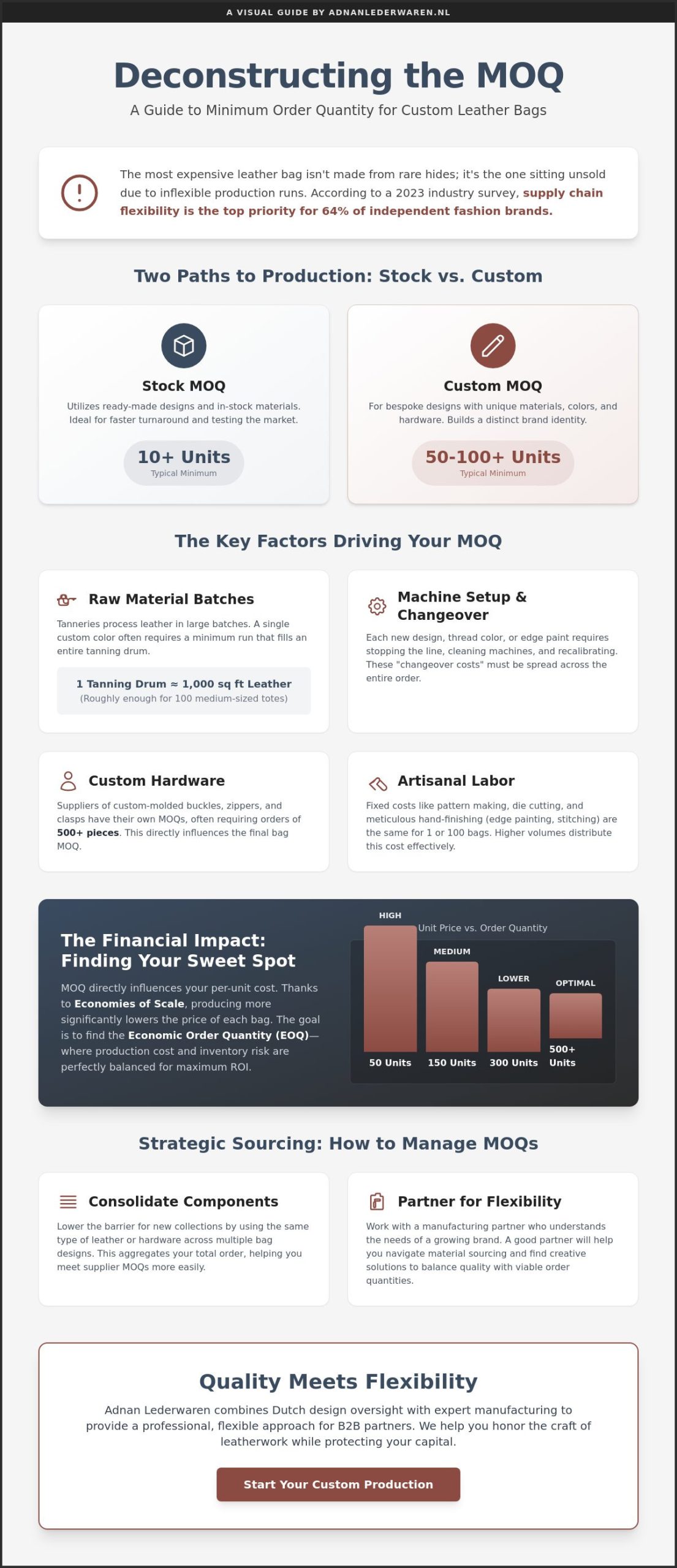
The most expensive leather bag in your collection isn’t the one made from rare full-grain hides; it’s the one sitting unsold in a warehouse because of an inflexible production requirement. You likely believe that high-quality craftsmanship should be accessible without risking your entire 2026 budget on a single production run. It’s frustrating when the minimum order quantity for custom leather bags feels like a barrier rather than a bridge to growth. According to a 2023 industry survey by the Leather Working Group, supply chain flexibility is now the top priority for 64% of independent fashion brands.
This guide will help you master these complexities to balance production costs, inventory risk, and the premium quality your brand represents. We’ll explore why these limits exist and provide a clear framework to calculate your return on investment across different volumes. You’ll also learn how to identify a manufacturing partner that values your brand’s longevity, characterful materials, and artisanal integrity as much as you do. By the end, you’ll have the confidence to make procurement decisions that protect your capital while honoring the craft.
For brands entering the luxury market in 2026, the minimum order quantity for custom leather bags represents the baseline volume required to make a production run economically viable. It’s not just a random number; it’s a calculation that ensures the workshop can cover its setup costs while maintaining high artisanal standards. In an era where sustainability and precision are paramount, MOQs allow manufacturers to allocate the necessary time for hand-finishing and rigorous quality control that defines premium leatherwork.
There’s a significant difference between “Stock MOQ” and “Custom MOQ.” Stock options usually involve ready-made designs where the manufacturer already holds the patterns and materials, often allowing for orders as small as 10 units. Custom MOQs, however, cater to bespoke designs and typically start at 50 to 100 units. These requirements protect the manufacturer and the brand from the supply chain volatility seen in 2025, ensuring that material sourcing and labor remain predictable and stable.
To see the intricate detail and labor involved in bespoke leatherwork, watch this demonstration of the carving and assembly process:
The first bag in a production run always costs more than the 100th. This is due to fixed costs like pattern making, die cutting, and machine calibration that don’t change regardless of the order size. By utilizing Economies of scale, brands can significantly lower their per-unit expenditure. In the context of premium leather goods, Economic Order Quantity (EOQ) is defined as the specific production volume where the costs of manufacturing and inventory holding are perfectly balanced to maximize brand profitability. Because leathercraft remains a labor-intensive process, low-volume runs often require higher MOQs to justify the hours spent on edge-painting and manual stitching.
When a brand requests custom hardware, such as engraved buckles or specific zippers, the minimum order quantity for custom leather bags often rises. Metal suppliers frequently demand their own MOQs of 500 pieces or more for custom molds, which directly impacts the bag manufacturer’s requirements. It’s a trade-off between achieving a unique brand identity and the desire for immediate availability. Adnan Lederwaren focuses on B2B wholesale to ensure that every product reflects consistent quality standards. This focus allows for a more streamlined production flow, where the integrity of the full-grain leather is never compromised for the sake of speed. Choosing a wholesale partner helps bridge the gap between artisanal tradition and modern business needs.
The minimum order quantity for custom leather bags isn’t a number pulled from thin air. It’s a calculated threshold rooted in the physical realities of the workshop and the tannery. When we discuss production volumes with B2B partners, we’re looking at the constraints of raw material batches and the labor-intensive process of preparing a production line. A single custom color requires a dedicated tanning drum, which often holds a minimum of 1,000 square feet of leather. If a specific tote design uses 10 square feet per unit, the math dictates a minimum run just to utilize that specific batch of leather.
Machine setup also plays a pivotal role. Every time we switch from a cognac-colored thread to a deep navy, or change the edge paint from matte to gloss, the production line stops. These transitions involve cleaning machines and recalibrating tensions. Understanding MOQs in the Supply Chain reveals that these “changeover costs” must be amortized across the entire order. Small batches don’t allow for this cost distribution, making the price per unit unsustainable for most retail models.
The “Yield Factor” is perhaps the most unique challenge in leatherwork. Unlike synthetic rolls, every hide is different. Full-grain leather carries the history of the animal, including natural marks and varying thickness. Our artisans must navigate these irregularities during the cutting process. In a typical production run, we account for a 20% waste factor. Higher volumes help us optimize hide usage, ensuring that the characterful, premium sections are used for the bag’s face while smaller offcuts become internal pockets or tabs.
Full-grain leather hides average between 45 and 55 square feet. Because we prioritize the integrity of the grain, we can’t simply “patch” pieces together. This affects the minimum order quantity for custom leather bags because large-panel designs require more hides to find enough flawless surface area. For brands exploring wholesale vegan leather bags, the MOQ logic shifts slightly. Since synthetics come in consistent 1.4-meter wide rolls, the “Yield Factor” is much higher, though material suppliers still demand their own minimums for custom textures or colors.
Custom designs require bespoke “clicker dies” — sharp steel blades used to punch out leather shapes with precision. For a complex backpack, we might need 15 separate dies. The initial investment in this tooling is significant. Furthermore, modern functional requirements like RFID-blocking technology add another layer of sourcing. Sourcing the specialized metallic fabrics used to shield wallets often requires purchasing 50-meter rolls, which naturally pushes the production minimum higher to avoid dead stock. At Adnan Lederwaren, we believe in transparency regarding these technical hurdles to help you build a sustainable brand. If you’re ready to discuss your specific design needs, reach out to our craft experts for a detailed consultation.
Choosing the right minimum order quantity for custom leather bags is a strategic financial decision that goes beyond simple unit costs. The price curve in leather manufacturing is steep. When you order 50 units, the fixed costs of creating initial brass molds for hardware or steel dies for cutting leather panels are spread across a very small pool. This results in a higher unit price that can squeeze your retail margins. By the time you reach 200 or 500 units, these fixed costs become negligible, allowing the inherent value of the leather to shine through without the heavy burden of setup fees.
Hidden costs often lurk behind the scenes of low-volume orders. Administrative overhead, customs clearance fees, and international shipping rates don’t scale linearly. A single shipment of 50 bags might cost 15 percent of your total budget in logistics alone, whereas a larger shipment of 500 bags could drop that figure to 4 percent. Calculating the Total Cost of Ownership (TCO) requires looking at these variables alongside the raw production cost. A higher MOQ might actually be cheaper in the long run because it reduces the frequency of these recurring administrative and shipping expenses.
Small batches of 50 units are excellent for exclusive boutique launches, but they often carry a premium price tag. At 200 units, you begin to see the “sweet spot” where manufacturing efficiency kicks in. By 500 units, the economies of scale are fully realized. It’s vital to remember that “cheap” low-MOQ manufacturers often compromise on the details. They might skip the reinforced stitching or use inferior edge paint that cracks within months. Adnan Lederwaren believes that true value lies in quality leather craftsmanship, which ensures your bags command high retail margins and build long-term brand loyalty.
The danger of over-ordering is real. Capital tied up in 1,000 unsold bags is capital you can’t use for marketing or new designs. However, under-ordering is equally risky in the 2026 market. Stockouts during peak seasonal trends lead to missed revenue and disappointed customers who may turn to competitors. Understanding the Technical Factors of MOQ in Manufacturing helps you see why certain leather types or custom hardware require higher minimums. Use your minimum order quantity for custom leather bags as a tool for market testing. Start with a manageable volume to validate your design, then scale up to maximize your profit margins once the demand is proven.
Finding the balance requires a deep dive into your projected inventory turnover. If you expect to sell 200 bags in six months, ordering that amount upfront prevents the “out of stock” badge from killing your momentum. This approach secures your supply chain while keeping your unit costs at a level that supports healthy business growth.
Managing the minimum order quantity for custom leather bags requires a blend of design foresight and smart negotiation. Growing brands often feel squeezed between high production thresholds and limited storage. To bridge this gap, focus on material consolidation. If you use the same high-quality, full-grain leather across four different silhouettes, your factory can purchase hides in bulk. This approach often allows a leather goods manufacturer to lower the MOQ per style because the total leather consumption remains high. It’s a practical way to offer variety without the burden of excessive inventory.
Another effective tactic involves the “Core Collection” strategy. By keeping your hardware finishes consistent, such as using only antique brass or brushed nickel, you eliminate the need for custom hardware runs. Custom-molded zippers or buckles usually require thousands of units. Sticking to premium, standard hardware allows you to pivot designs quickly while keeping your entry barriers low. You can also utilize pre-order models. By using 2025 customer data to justify larger production runs for 2026, you move from guessing to data-driven manufacturing. This reduces the risk of deadstock and improves your cash flow.
Design choices directly impact your manufacturing threshold. Simplifying internal pockets and using high-quality but standard linings can significantly lower the labor hours required for each piece. Complex multi-compartment bags often trigger higher MOQs because they require specialized assembly lines. When you work with a partner who understands wholesale leather handbags trends, you can identify which features add value and which ones just add cost. Using standard hardware finishes doesn’t just lower costs; it cuts lead times by 15 percent, as these materials are usually readily available in the workshop.
Loyalty is your strongest negotiation tool. As trust grows, manufacturers are often more willing to offer tiered pricing or flexible MOQs. Transparent communication about your 2026 growth projections helps a factory plan their capacity. At Adnan Lederwaren, we focus on supporting scaling businesses. We guide you from your first sample through to bulk distribution, ensuring the minimum order quantity for custom leather bags doesn’t stall your momentum. We believe in the beauty of the leather and the success of the brands that use it. When we see a clear roadmap for your brand’s future, we work with you to make production feasible.
Ready to scale your collection with a partner who values craftsmanship and growth? Contact Adnan Lederwaren today to discuss your custom production needs.
Choosing the right partner for your brand means finding a balance between creative vision and logistical reality. At Adnan Lederwaren, we’ve refined our process to offer a distinct advantage: the precision of Dutch design combined with the deep-rooted expertise of Indian leather artisans. We understand that the minimum order quantity for custom leather bags is often the biggest hurdle for emerging brands and established retailers alike. That’s why our approach focuses on professional B2B needs while maintaining the flexibility required for bespoke customization.
Our production model is built on transparency and waste reduction. By 2026, we’ve implemented advanced cutting techniques that reduce leather scrap by 15% across all production lines. This efficiency allows us to keep our MOQs accessible without sacrificing the integrity of the material. From wholesale small leather goods like cardholders and wallets to premium travel duffels, our catalog serves as a foundation for your unique brand identity.
Our headquarters in Almere serves as the central hub for our international B2B clients. You’ll get local support and clear communication throughout the design phase. Every custom order undergoes a rigorous four-stage inspection process before it leaves our facilities. This ensures that the characterful, full-grain leather we use meets our exact standards for durability and aesthetics. In our India facilities, we’re fully committed to 2026 ethical labor standards, ensuring fair wages and safe working conditions for every artisan who contributes to your collection.
Launching a new line shouldn’t feel like a gamble. To get started, you can request a quote and a physical sample of your design. When you reach out, please include a detailed tech pack. A complete tech pack should feature dimensions, hardware preferences, and material specifications. This level of detail helps us provide an accurate minimum order quantity for custom leather bags and a precise price estimate right from the start. We’ll work with you to ensure the final product reflects the timeless class your customers expect.
Ready to bring your vision to life? Partner with Adnan Lederwaren for your next custom collection and experience the difference that authentic craftsmanship makes.
Success in the B2B leather market requires a clear understanding of how production volume impacts your bottom line. By 2026, brands that master the balance between unit costs and inventory turnover will lead the industry. Finding the right minimum order quantity for custom leather bags isn’t just about meeting a factory’s limit; it’s about aligning your sourcing with your brand’s growth trajectory. Since 2010, Adnan Lederwaren has operated as a B2B specialist, providing the technical expertise needed to bridge the gap between artisanal quality and commercial scalability. Our Dutch-managed quality control ensures every piece meets rigorous standards before shipping globally from our hub in Almere, Netherlands.
Choosing a partner who values the natural character of full-grain leather as much as you do makes all the difference. We’re here to help you navigate these technical factors with transparency and professional insight. Let’s transform your designs into a timeless collection that grows alongside your business. Request a Custom Quote for Your Leather Collection today and take the next step in your brand’s journey. We look forward to crafting something exceptional together.
The typical minimum order quantity for custom leather bags ranges between 50 and 100 units per design for most professional manufacturers. This volume ensures that the factory can source high-quality full-grain hides and custom hardware while maintaining production efficiency. Some artisanal workshops might accept orders as low as 20 units, but the price per item often increases by 30% to account for the specialized setup time required for small batches.
You can usually mix colors of the same design, provided each color meets a specific sub-limit, such as 20 or 25 units. This flexibility depends on the tanning process since leather dye vats have fixed capacities. If you select standard stock colors like deep black or cognac, we’re often more flexible with color distribution within your total minimum order quantity for custom leather bags.
The MOQ for vegan leather is typically higher because synthetic materials are produced and sold in large rolls, often 500 to 1,000 meters long. Unlike genuine leather hides that are sold individually, synthetic suppliers require manufacturers to purchase entire rolls. This often results in a minimum requirement of 200 units or more per style to avoid significant material waste and storage costs.
The minimum order quantity for custom leather bags doesn’t include the cost of the initial prototype or sample. You’ll pay a separate development fee for the first sample, which covers the labor for pattern making and sourcing specific materials. Many manufacturers will credit this sample fee back to your account if your subsequent bulk order exceeds 100 units.
Adding a custom embossed logo or RFID-blocking lining usually requires a minimum of 50 units to justify the cost of the metal mold or specialized fabric. For logos, a brass stamp must be CNC-machined, which is a fixed cost regardless of the order size. RFID protection requires specific shielding inserts that are often purchased in 100-meter increments, which can influence the final production volume requirements.
If you can’t meet the standard MOQ, you’ll likely have to pay a “small run” surcharge, which typically adds 20% to 50% to the unit cost. Another effective strategy is to choose from the manufacturer’s existing “white label” collection. This allows you to add your branding to pre-designed, high-quality items without the high volume requirements of a completely bespoke development process.
Lower MOQs of 10 to 25 units are common for smaller corporate items like cardholders, luggage tags, or tech sleeves. These products utilize leather offcuts and require less assembly time, making small batches more economically viable. For premium executive briefcases or travel bags, the requirements remain stricter because the craftsmanship involves more complex patterns and longer stitching times.
Production lead times generally range from 4 to 8 weeks after the final sample is approved and the deposit is paid. This period includes 14 days for sourcing premium hides and 20 to 30 days for the actual hand-stitching and assembly process. During peak periods, such as the three months leading up to the holiday season, lead times can extend by an additional 15 days due to high demand.


You deal directly with the manufacturer. We control planning, quality and pricing ourselves.

One point of contact from first question to delivery. English, Dutch and German.

Approve a physical sample first. We are happy to sign your NDA.

Incoming leather, after cutting, during production, and a final inspection before dispatch.
 English English
 Nederlands
 Deutsch
 Français
 Italiano
 Español
Comments are closed.