

Own family facility
You deal directly with the manufacturer. We control planning, quality and pricing ourselves.

Buyers who search for sustainable leather sourcing usually want answers to a few practical questions. Responsible leather sourcing comes down to facts you can check: where the leather comes from, how it was tanned, which chemical requirements the finished product has to meet, and under what conditions it was made. This guide explains each of these in plain terms, lists the questions worth asking a leather goods manufacturer, and sets out what we can supply for your project.
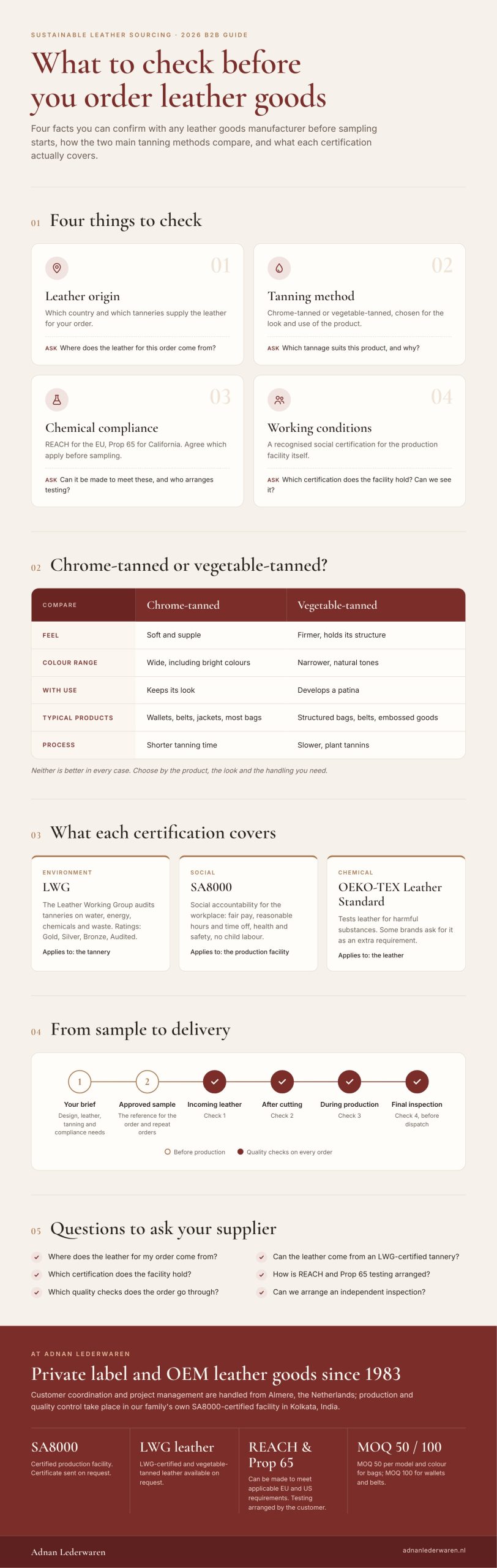
For a brand, retailer or corporate buyer, “sustainable leather” is not a label you can take at face value. Responsible sourcing is not a label on the finished product either. It is a set of facts you can confirm with your manufacturer before production starts:
A manufacturer that can answer these questions clearly, and put the answers into your sample and order specifications, gives you a sound basis for your own customers’ questions.
Tanning turns a raw hide into a stable material that does not decay. The method affects the look, the handling, the colour options and the way the leather ages.
Chrome tanning is a widely used process worldwide. It produces soft, supple leather that takes a wide range of colours and keeps its shape well. It suits wallets, belts, jackets and most bags. Well-run tanneries manage chromium carefully, and EU rules limit chromium VI in leather articles that come into contact with the skin.
Vegetable tanning uses tannins from bark, wood and other plant sources. The process is slower. The leather is firmer, holds embossing well and develops a patina with use. It suits structured bags, belts and goods where an aged, natural look is part of the design. Colour options are narrower than with chrome-tanned leather.
| Chrome-tanned | Vegetable-tanned | |
|---|---|---|
| Feel | Soft and supple | Firmer, holds its structure |
| Colour range | Wide, including bright colours | Narrower, natural tones |
| With use | Keeps its look | Develops a patina |
| Typical products | Wallets, belts, jackets, most bags | Structured bags, belts, embossed goods |
| Process | Shorter tanning time | Slower, plant tannins |
There is no single right answer. Start from the product: how soft it should feel, which colours you need, how it will be used and how it should look after a year. Then choose the tanning method that fits. If your brand has a policy on tanning, include it in your first brief so it is part of the sample.
If you sell in the EU, the REACH regulation restricts certain substances in articles placed on the market, including chromium VI in leather. If you sell in California, Proposition 65 requires a warning for products that can expose consumers to listed chemicals above set levels.
Agree before sampling which requirements apply to your markets and who arranges testing. Our leather goods can be made to meet applicable EU and US requirements, including REACH and Prop 65. Testing is arranged by the customer or on the customer’s behalf, for example through an independent laboratory.
The Leather Working Group audits tanneries on environmental performance, including water, energy, chemical and waste management. Tanneries are rated Gold, Silver, Bronze or Audited. An LWG rating belongs to the tannery, not to the finished bag or wallet. If your brand requires it, ask whether the leather for your order can be sourced from an LWG-certified tannery. LWG-certified leather is available on request for your project.
SA8000 is a social accountability standard for workplaces. It covers fair pay, reasonable working hours and time off, health and safety, and no child labour. It applies to the production facility. Our production facility is SA8000-certified, and we send the certificate to buyers on request.
The OEKO-TEX Leather Standard tests leather for harmful substances. Some brands ask for it as an additional requirement. If your brand works with it, mention it in your brief so it can be discussed for the specific leather.
A good supplier answers these questions clearly and without hesitation:
Vegan leather is not automatically the better choice. Many vegan materials are polyurethane-based, and they generally do not last as long as real leather. Leather that is well made and well cared for stays in use for years. If your brand still needs a vegan option for bags, compare the material composition and the expected lifespan before you decide. We make vegan leather bags with an MOQ of 250 pieces per model and colour.
Adnan Lederwaren is a family business, founded in 1983, that makes leather goods under the buyer’s brand name. Customer coordination and project management are handled from Almere, the Netherlands; production and quality control take place in our family’s own SA8000-certified facility in Kolkata, India.
Read more about our quality checks, certification and working conditions, or see how we make leather goods under your brand through private label and OEM production.
Ask the supplier directly which country and which tanneries supply the leather for your order, and whether an LWG-certified tannery can be used. Put your requirements in the brief, so they become part of the approved sample.
Neither is better in every case. Vegetable-tanned leather is firmer and develops a patina; chrome-tanned leather is softer and offers more colour options. Choose by the product and the look you want.
Yes. LWG-certified leather is available on request. Include the requirement in your first brief so it is part of the sample development.
Our leather goods can be made to meet applicable EU and US requirements, including REACH and Prop 65. Testing is arranged by the customer or on the customer’s behalf.
Yes. We send it on request.
Yes. Independent inspection, for example by SGS, is welcome. Please arrange it with your account manager.
For real leather: MOQ 50 pieces per model and colour for bags and jackets, and MOQ 100 for wallets, belts and small leather goods. Vegan leather bags: MOQ 250 pieces per model and colour.
Tell us which product you plan to source, the quantities per model and colour, and any leather, tanning or compliance requirements you have for sustainable leather sourcing, such as LWG-certified or vegetable-tanned leather. Your account manager will get back to you.



You deal directly with the manufacturer. We control planning, quality and pricing ourselves.

One point of contact from first question to delivery. English, Dutch and German.

Approve a physical sample first. We are happy to sign your NDA.

Incoming leather, after cutting, during production, and a final inspection before dispatch.
Comments are closed.