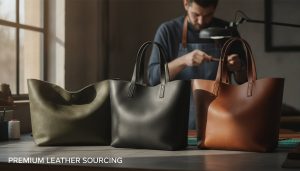


Own family facility
You deal directly with the manufacturer. We control planning, quality and pricing ourselves.

A unique selling proposition (USP) is the reason a customer picks your handbag over the many others at a similar price. Without one, a new brand competes on price alone. This guide shows how to find a USP for a handbag brand, test it, and build it into the product itself.
| Source | Examples |
|---|---|
| Function | A laptop compartment that fits a specific size, an organised interior, a convertible strap |
| Material | A specific leather grade or finish, a vegan alternative, a distinctive texture |
| Design | A recognisable shape, hardware detail or colour palette |
| Customer group | Bags designed for a profession, an activity or a size of person |
| Service | Personalisation, repair, a long warranty, a clear story about how the bag is made |
A USP has to be visible and tangible. Specify it in the brief, so it appears on the physical sample and in every production run: the interior layout, the leather, the hardware detail, the strap system or the branding. Claims you make about materials or working conditions must be true and documented.
Customer coordination and project management are handled from Almere, the Netherlands; production and quality control take place in our family’s own SA8000-certified facility in Kolkata, India. Your account manager handles your project from the first question to delivery, in English, Dutch or German.
Yes. With private label, an existing model can be adapted in leather, layout, straps, hardware and branding.
One or two models that show the USP clearly is usually enough to test the market.
50 pieces per model and colour for real-leather bags.
Read how to start a private label handbag line. Request a quote or book a call with your account manager.


You deal directly with the manufacturer. We control planning, quality and pricing ourselves.

One point of contact from first question to delivery. English, Dutch and German.

Approve a physical sample first. We are happy to sign your NDA.

Incoming leather, after cutting, during production, and a final inspection before dispatch.
Comments are closed.